Former leading California Democrat explains why she switched parties, talks problems with education
California Democrat Gloria Romero was a trailblazer, but frustrations with the state’s education policy caused her to become a Republican.
A member of the California Assembly from 1998 to 2010,…
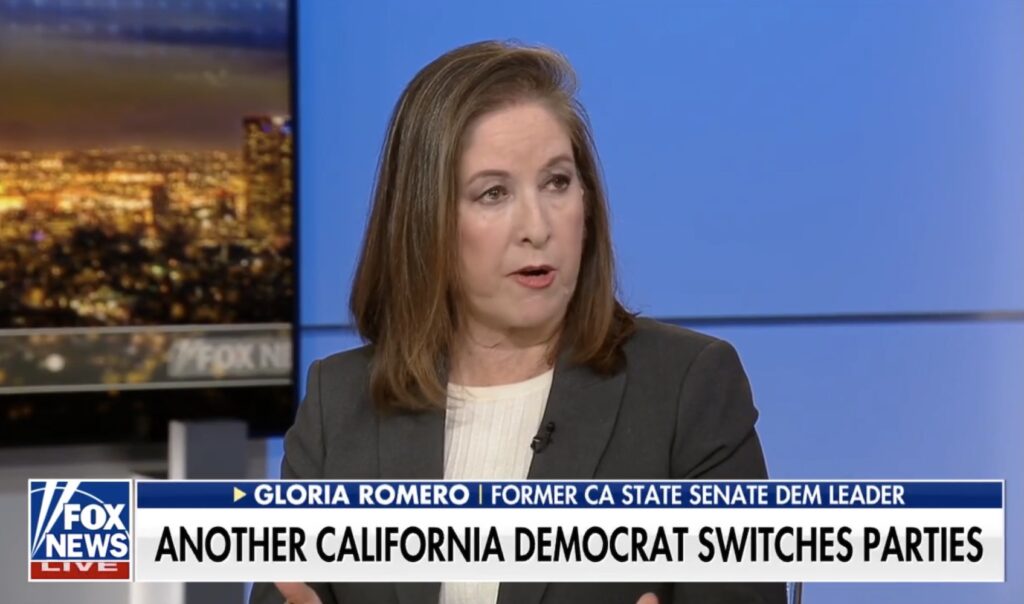
California Democrat Gloria Romero was a trailblazer, but frustrations with the state’s education policy caused her to become a Republican.
A member of the California Assembly from 1998 to 2010, Romero was the state’s first-ever female Senate Majority Leader and served as the chairman of the Education Committee.
Self-described as left of center, Romero said she worked across the aisle and wasn’t afraid of pushing back against the state teachers’ union, which she called “the most powerful political entity in California.”
However, after years of battling entrenched problems with public schools – and an unpredictable presidential election – Romero decided to become a Republican.
“You almost have to choose which side are you on, and you can choose to say, ‘I’m going to stay on the side of vested interests and power, and I will have a political career in front of me, or I will take on the system [. . .] and your political career is over,’” Romero said in a recent interview.
She made the switch after seeing the Democrat Party’s implosion in the 2024 presidential race – and credited prominent figures such as Robert F. Kennedy Jr. and Tulsi Gabbard for leading the way.
One of Romero’s main frustrations involved the lack of meaningful education reform as the system is effectively held hostage by the teachers’ union.
“Our education system in California – it’s really not an education system. It’s a public works system, and the system is designed to work for the adults,” Romero explained. “You can’t blame COVID, you can’t blame the pandemic. This has been generational.”
Recent national testing proves her point.
In 2024, just 28% of California’s 4th-graders could read proficiently. The scores are similarly dismal for 8th-graders, who scored 28% in reading and 26% in math.
Romero notes even worse outcomes for minority students, saying only 8% of black and 23% of Latino 4th-graders meet grade-level standards in reading.
Despite clear problems, the education establishment rejects meaningful reforms, according to Romero.
“When you see over and over, year after year, decade after decade, generation after generation, crappy scores? I mean, come on, that’s the definition of insanity,” she said. “The same thing keeps being done and the outcomes aren’t improving; they’re getting even worse.”
Instead of herding students into schools according to their zip code, parents should be able to choose any public school – a policy known as open enrollment – or take their student’s education dollars elsewhere, Romero argued.
If “healthy competition” existed, school districts would start to “offer a better product,” she said, adding Californians should “be able to shop around for the school of your choice.”