Wisconsin manipulating school data, deceiving parents, policy expert says
Wisconsin’s education department is skewing test scores to deceive parents, a public policy expert argues.
The Wisconsin Department of Public Instruction (DPI) is distorting its own data to…

Wisconsin’s education department is skewing test scores to deceive parents, a public policy expert argues.
The Wisconsin Department of Public Instruction (DPI) is distorting its own data to make its public education system look better than it is, alleges Will Flanders, research director for the Wisconsin Institute for Law & Liberty (WILL).
Flanders accuses DPI of exhibiting a “pattern of gaslighting families.”
“Parents trust that when the state puts forward a set of accountability ratings, those ratings reflect reality – not a political calculation,” he wrote. “If accountability measures become nothing more than political tools, they fail in their essential role of telling the truth about school performance and demanding improvement where it is needed most.”
Public schools have been the default choice of many families in the past, but that may not be the case in the future.
Earlier this year, a National School Choice Awareness Foundation survey found 60% of parents had considered changing schools in 2024, and 28% did so. Of those who did transfer, 27% changed to an online, home or microschool, 14% to a private or parochial school, and 31% to a public charter or magnet school.
As parents thus become more empowered, government-run public schools may be looking to make themselves more attractive – and some may feel pressure to even bend the truth to do so.
Flanders accuses DPI of “repeated efforts to blur, soften or outright manipulate” accountability metrics, as he recalls a recent lowering of proficiency standards that created “an 8-10% increase in reported proficiency, despite no actual gains in student achievement.”
Now, he says, DPI has proposed watering down its standards yet again to make schools and districts appear more successful.
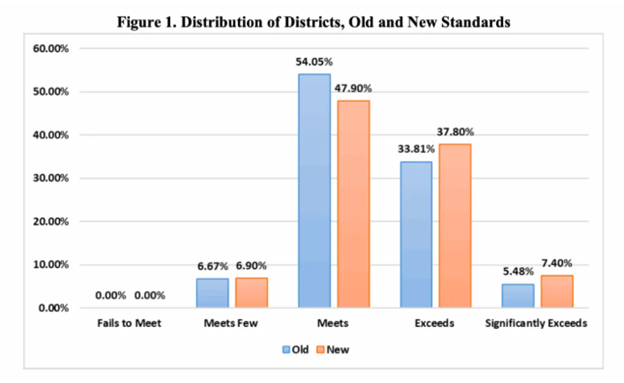
The above chart – produced by WILL – demonstrates how 2% of districts would move into the top category and 4% into the second highest under the newly proposed standards.
“This paints a rosier picture of school performance than the data justifies, giving taxpayers and families a false sense of security,” observed Flanders. “Most troubling of all, the new report card maintains the pattern of never classifying a single school district, and very few schools, in the entire state as ‘fails to meet expectations.’”
According to the 2024 National Assessment of Educational Progress (NAEP) exams, just 31% of Wisconsin 8th graders are proficient in reading and only 37% meet standards in math.
However, the state continues to rate over 90% of its school districts as meeting or exceeding expectations.
“At the end of the day, accountability systems exist to ensure that schools serve students – not the other way around,” Flanders concluded.
“When the system is designed to avoid embarrassment for the adults in charge rather than to highlight the real challenges facing our children, it is the students who pay the price.”