Analysis: World cracking down on immigration abuse, a decade after ‘fact-checks’ called Trump claim false
Some have spent the last 10 years insisting President Donald Trump was imagining immigration problems that didn’t exist.
In fact, some media even argued that…
Some have spent the last 10 years insisting President Donald Trump was imagining immigration problems that didn’t exist.
In fact, some media even argued that cracking down on illegal immigration would create more fraud not less, turning illegal immigrants into victims of their host country.
A lot has changed over a decade, including the disappearance on the front page of fact-checks on the subject.
Now countries with diverse political systems are taking action against versions of the same problem Trump described: lack of respect for local culture and the inability to integrate, with relaxed visa and immigration practices as a gateway towards not just bad behavior, but criminal behavior.
This isn’t a story about an ideology spreading across the globe. It’s a story about a single structural problem showing up everywhere: liberalized immigration, travel, tourism and visa rules that require a long second and third look – because governments of every political stripe are looking and concluding globalization of immigration came with steep costs.
Thailand is one of the more stunning examples.
Once considered a paradise for partiers, where almost anything goes, Thailand is now running a variety of separate crackdowns at once aimed at immigration abuse.
The “a-ha” moment for the Southeast Asia tourist destination came with the realization in 2025 that decriminalization of cannabis was attracting the wrong type of tourists – after a series of high profile incidents involving foreigners and drugs.
“We’re not a country to get you high. We’re the land of smiles, but we’re not that kind of smile,” said Tom Kruesopon, a local businessman who championed decriminalization, but now welcomes the reversal.
The Interior Ministry has also ordered provincial authorities to revoke visas and deport foreigners on the spot for breaking the law, intimidating Thai citizens, or behaving in ways that damage the country’s culture and traditions.
“Foreigners who enter Thailand cannot act like influential figures, do illegal things, bully the people of the host country, or behave in ways that go against Thailand’s morals, culture or traditions,” said Interior Minister Arsit Sampantharat.
A separate enforcement effort targets nominee ownership in which foreigners use Thai citizens as fronts to illegally control businesses and property in sectors such as tourism, hotels and real estate.
“Investigators increasingly encounter nominee companies being used to purchase land, move funds internationally, facilitate cryptocurrency activity, operate illegal lending schemes, or obscure beneficial ownership,” said Compliancia Thailand, a local business consultancy. “As enforcement agencies intensified investigations into transnational scam operations and money laundering activities during 2025, nominee companies became a major point of attention.”
A third track closes the loophole tourists have used to live in Thailand indefinitely without a residency visa, capping tourist extensions at twice a year.
Cambodia’s visa and immigration problems are darker and have already produced a shooting war.
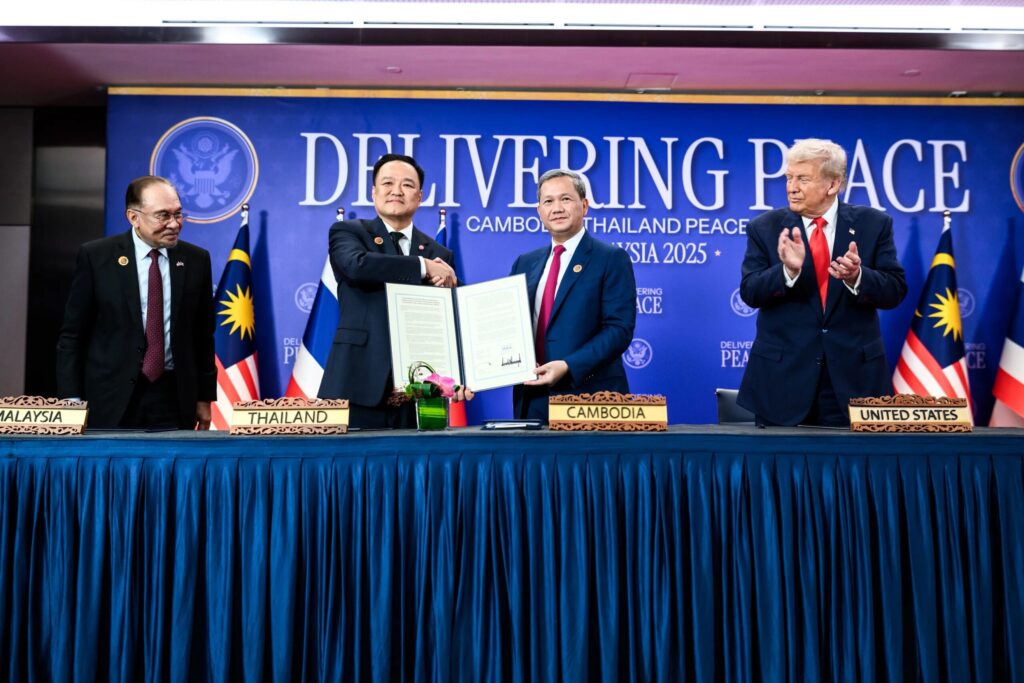
Thailand bombed Cambodian casino and hotel complexes it said were functioning as forced-labor scam centers operated by foreigners, in a conflict that flared in July 2025, paused, and resumed in December.
The country hosts more than 50 scam compounds generating over $12.5 billion a year, roughly half its formal economy, with senior officials and business elites implicated in running them, according to the data by the Center for Strategic and International Studies.
The scam economy is a result of Cambodia’s desire for foreign money that can be laundered and foreign workers who can be trafficked, both of which generate a skim for the officials.
But what happens in Cambodia doesn’t stay in Cambodia, thanks to a globalized and mobilized visa system.
When Cambodia’s enforcement intensified, under pressure by the U.S. and Thailand, the scam operators didn’t disappear.
They moved quickly.
And Vietnamese police followed quickly as well.
Police in Phu Tho province subsequently arrested a 19-person gang that had “previously participated in fraud and property embezzlement activities in Cambodia,” who had organized the illegal entry into Vietnam of dozens of Chinese citizens into the country.
In a single month, the group rented entire resorts and villas in remote areas to relaunch the same operation that had just been shut down across the border, reported the Associated Press.
“The perpetrators’ goal was to find ‘prey’ – Chinese citizens in need of loans – then impersonate employees of lending platforms, guide borrowers through the loan application process and subsequently defraud the victims of their assets,” said the local police.
The phenomenon of booting foreigners accused of bad behavior, visa fraud, illegal immigration, isn’t just concentrated in Southeast Asia.
Japan’s government released a new framework in January replacing immigration guidelines that had been in place since 2018.
Under Japan’s updated rules, permanent residency can now be revoked for a variety of circumstances: unemployment over six months, tax delinquency above $3,100, unauthorized absences from Japan exceeding 180 days, criminal convictions including license-suspending traffic violations or application fraud.
Japan’s Minister of Economy, Trade and Industry and Security Kimi Onoda said the government would “firmly respond to illegal activities and deviations from the rules by some foreigners.
“We will create a situation where there are no foreigners in Japan who do bad things.”
In Australia, the aim is to cut annual net migration from 301,000 to 225,000 by 2027-28, reported the Sydney Morning Herald.
“In short, if a visa holder undermines our democratic values, doesn’t respect the law, or demonstrates they don’t respect our core values, they will be booted out of Australia,” said Opposition Leader Angus Taylor
And Canada’s Liberal government is driving one of the most aggressive course reversals in the Western world.
Canada is cutting temporary residents below 5% of the population by the end of 2027, driving a population drop for the entire country.
The trigger was student visa fraud.
Auditors found between 2023 and 2024, immigration officials identified more than 153,000 students who were potentially violating visa rules, while authorities had the funding to investigate just 2,000 cases, according to a national university publication.
Immigration officials told Parliament there would be no more “soft touch” on international student visa fraud.
The list goes on: South Korea is running immigration raids in subway stations and markets against undocumented workers; Germany has made it dramatically harder to get asylum and easier to get deported.
Even the far-left European Union has suddenly lurched to the right as it passed stringent immigration restrictions.
The 418 votes to 218 that passed the immigration reform crackdown was accompanied by chants of “send them back,” in reference to illegal immigrants.
Nothing better dramatizes the crossroads at which the world stands on immigration than the United Kingdom, which is behind the curve compared to many others.
Public opinion has turned against the U.K. government’s open border stance after several high-profile cases, including Henry Nowak and the Belfast beheading, exposed a broken system.
A detailed report on immigrant gang rape culture in the U.K., released this week, only deepened the sense that something has gone badly wrong.
And unlike in the countries cited above, the British government seems slow to move, or to recognize the problem.
It’s not that people hate immigrants, it’s that some immigrants are eroding the quality of life worldwide and British Prime Minister Keir Starmer seems willfully blind to what’s going on.
The Spectator called it an “all-consuming divorce from political reality.”
“The anger is extraordinary,” Tim Montgomerie, who was once an adviser to Boris Johnson, the former Tory prime minister told the New York Times. “It’s off the scale. People feel that the government just has no idea how hard their lives are.”
After a decade of fact-checking, a demonstrable number of governments have the idea and are working to solve it.