Depleted US interceptor stockpiles reveal long-term defense weakness
A new report warns Iran’s low-cost drones and missiles are systematically depleting U.S. and allied air defense interceptor stockpiles during the ongoing conflict.
The depletion…
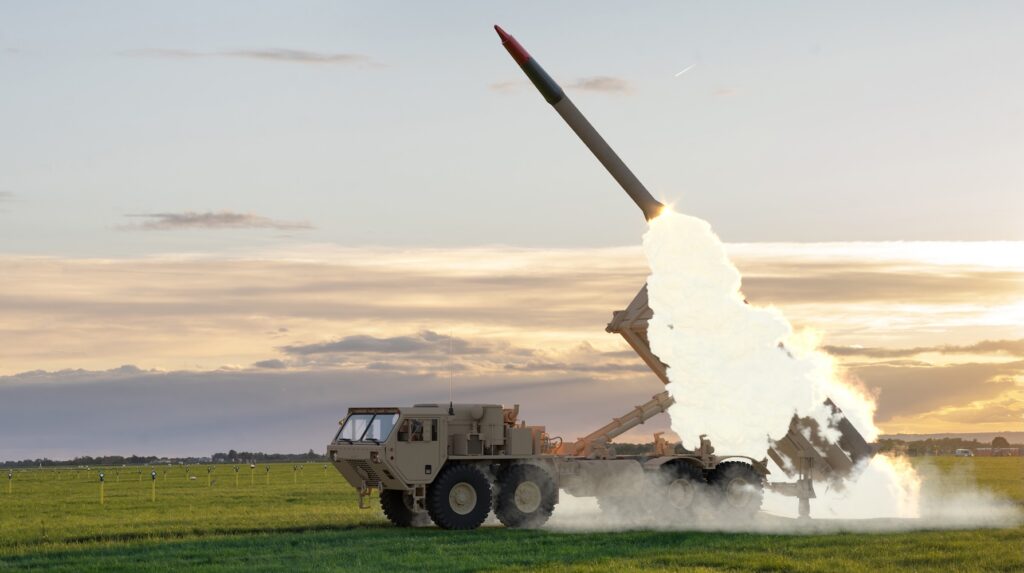
A new report warns Iran’s low-cost drones and missiles are systematically depleting U.S. and allied air defense interceptor stockpiles during the ongoing conflict.
The depletion is raising serious questions about long-term air defense sustainability.
It likely won’t have an effect on the current engagement, but it could have an effect on how adversaries attack U.S. and allied forces in the future.
While the vast majority of Iranian projectiles have been intercepted, the cheapest weapons in Iran’s arsenal are depleting America’s most costly air defense stockpiles, according to a report obtained by Fox News Digital from the Jewish Institute for National Security of America (JINSA).
The cost imbalance demonstrates the problem, especially against a larger adversary, such as China.
A single THAAD interceptor costs roughly $15 million, while an Iranian drone costs about $20,000.
During the June 2025 12-day Iran attack, the U.S. fired 150 THAAD interceptors.
This rate of fire depleted the U.S. inventory between 20-50%, according to a previous report issued by the Center for Strategic and International Studies (CSIS) in December 2025.
And those stockpiles have not yet been fully replenished, with the production pipeline used to make these missiles slow – measured in years, not months.
Now, four weeks into the latest conflict, some fear the strain is spreading across the coalition.
Bahrain may have expended up to 87% of its Patriot missiles, said the JINSA report.
Likewise, UAE and Kuwait have burned through roughly 75% and 40%, respectively, of their air defense missiles.
The JINSA report also noted Israel is showing signs of air defense rationing, declining to intercept some threats.
That’s one reason why both the U.S. and Israel have concentrated on attacking Iranian defense production sites making drones and missiles.
“Obviously, the U.S. is trying to hit the production sites, but you have different ways to produce these frames,” Yasir Atalan of CSIS told the New York Times.
Atalan added production isn’t necessarily easy to track because it’s decentralized with no need for a huge industrial footprint.
Another problem is how drone and missile production isn’t confined just to Iran, but is distributed throughout China, Russia and North Korea, JINSA said.
Before the conflict began, Joint Chiefs Chairman Gen. Dan Caine warned President Donald Trump a protracted campaign could impact weapons stockpiles meant for other theatres such as the Pacific.
A chart by CSIS indicates from about 2023 onward, the Biden administration stopped taking deliveries of THAAD on behalf of the U.S. while foreign deliveries proliferated.
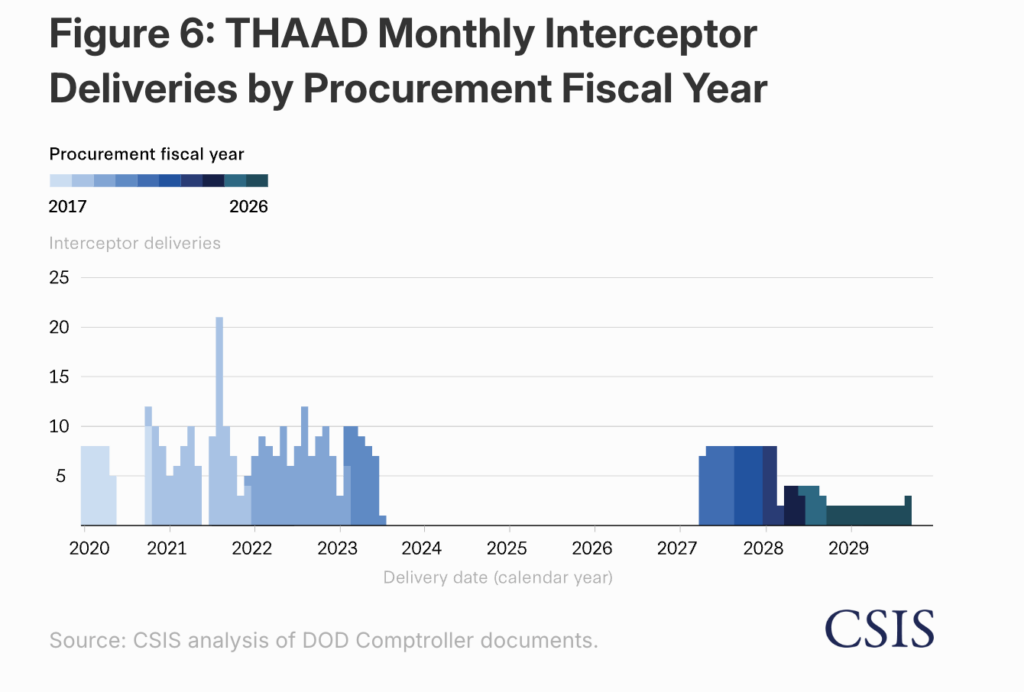
In 2025, the U.S. authorized more purchases to replenish its stock, but those purchases won’t be ready until 2027.
Most analysts are careful to note the depletion problem likely does not threaten the outcome of the current conflict.
Iran’s launches dropped 86% from day one after American strikes degraded launchers, command nodes and production sites, noted the Long War Journal.
The bigger strategic concern centers on China.
“The most benign outcome for China would be America tied down in another regional conflict, depleting munitions that it could have used in Asia and allowing Beijing to reap the geopolitical benefits of global unease over US power,” noted the European Council on Foreign Relations.
In a future Taiwan-takeover scenario, China would surge low-cost munitions, such as drones, across multiple theaters simultaneously, activate regional proxies to attack allies and let economic conditions erode even before their main force moves.
It would be a similar strategy to Iran’s, only on a grander scale.
Potential remedies to the air defense shortage include directed energy systems, such as Israel’s Iron Beam laser platform that can intercept drones at a fraction of the cost of kinetic missiles, noted the Times of Israel.
The U.S. also launched the Munitions Acceleration Council to increase production rates of some air defense missiles.
None of these fixes are immediate, however.
Ukrainian experts could help advise, as they now have years of hard-fought experience bringing down Russian drone technology.
“Ukraine knows how to shoot down the exact drones that are coming at these Gulf states, because those are the Iranian drones that the Russians have been using against them,” said Rebeccah Heinrichs at the Hudson Institute.
Other analysts note the depletion worries could be overblown.
“I believe that the amount of interceptor missiles was something that was taken into consideration in both the U.S. and Israel,” Tal Inbar, a veteran expert on aviation policy, space and missile systems, told The Times of Israel.
The operational plans also considered the length of the campaign, as well as plans to hit certain locations in Iran to stop strikes, he added.
Still, what adversaries take away from the current conflict may prove as consequential as the conflict’s outcome itself.