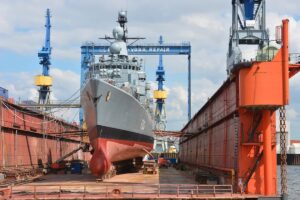
Golden Fleet takes shape as Trump’s budget chief pushes fifth naval shipyard
The White House is pushing to add a fifth public shipyard to the U.S. Navy’s maintenance capacity, according to Office of Management and Budget (OMB) Director Russell…
The White House is pushing to add a fifth public shipyard to the U.S. Navy’s maintenance capacity, according to Office of Management and Budget (OMB) Director Russell Vought.
The announcement signals the administration’s determination to back its most ambitious naval expansion since World War II with real industrial capacity.
Vought made the announcement at The Washington Times’ IndoPac 2026 event Wednesday, a national security conference on U.S. maritime power.
The OMB push comes after Acting Navy Secretary Hung Cao signaled interest in a fifth naval shipyard on the West Coast to bolster submarine readiness.
“As we continue to develop the Golden Fleet,” Cao said while visiting U.S. maritime strategic partner Vietnam, “we are not just preparing for future crises together; we are forging stronger bonds of trust and cooperation that are the bedrock of a secure and stable Pacific region.”
Vought also revealed that OMB has created a dedicated shipbuilding office within the budget office to drive implementation of President Donald Trump’s April 2025 executive order on restoring American maritime dominance.
“If we’re going to spend $1.5 trillion or have the types of direct foreign investment that’s coming in, we want to make sure that we have the ability to have enough public shipyards to do maintenance,” said Vought. “To do it at scale is something that is absolutely vital.”
The announcement comes as Trump’s FY2027 budget requests $65.8 billion for shipbuilding alone, as the U.S. tries to close the gap with China’s robust shipbuilding economy, The Washington Times reported.
The plan calls for expanding the Navy’s fleet to 450 ships by 2031, up from 295 today, which would exceed China’s 370-ship navy, the newspaper noted.
The U.S. currently has four public shipyards: Norfolk Naval Shipyard in Virginia, Portsmouth Naval Shipyard in Maine, Puget Sound Naval Shipyard in Washington and Pearl Harbor Naval Shipyard in Hawaii, according to Breaking Defense.
All four handle maintenance overhauls for nuclear-powered carriers and submarines, and all four are under an upgrade program launched in 2018 that’s scheduled to take 20 years, according to the defense trade publication.
The fifth shipyard proposal is part of a broader maritime revival strategy the administration has been building since Trump signed his maritime dominance executive order.
The White House released its Maritime Action Plan in February, a document covering shipbuilding capacity, workforce development, commercial fleet expansion and national security.
“We will soon revitalize our once-great shipyards with hundreds of billions of dollars in new investments and people coming from all around the world…to build ships in America,” said Trump. “We want them built in America.”
The legislative vehicle for much of this agenda is the SHIPS Act, a bipartisan bill with co-sponsors from both parties in both chambers.
“I’ve never seen so much energy on shipbuilding before,” Garrett Rice, president of Master Boat Builders Inc. of Coden, Alabama, told WorkBoat. “We couldn’t be more excited.”
But despite genuine enthusiasm on Capitol Hill, the bill has been referred to 12 House committees.
A congressional staffer told WorkBoat if it doesn’t advance before the August recess, it’s unlikely to pass this year.
The Iran war supplemental, which the White House is requesting at $88 billion, is crowding the fiscal calendar.
The strategic rationale for the maritime push is not complicated.
Since 2016, China has been building ships at a breakneck pace.
Statistics provided by the Center for Strategic and International Studies (CSIS) show China’s ships are newer and its shipyards are more productive.
But it’s not just U.S. military might that is lacking.
The U.S. accounts for 0.1% of global commercial shipbuilding output while China’s share was 53% in 2024, CSIS said.
Foreign-built ships carry 99% of American international trade by volume, WorkBoat said.
The OMB shipbuilding office Vought described is an institutional mechanism that will assign resources to maximize American maritime dominance.
The budget chief said he has “the ability to bulldoze bureaucracy” in pursuit of Trump’s goal, according to The Washington Times.
“What’s different this time is that the president, the administration, put the shipbuilding office within OMB almost as if it’s a stand-alone management division,” said Vought. “I view it as kind of that seal of importance to the country that we’re always going to have governmentwide emphasis on maritime dominance, on shipbuilding, on using our resources – all of government – to maintain adequate shipbuilding in this country, both commercial and military.”
The goal, in Vought’s framing, is to return to Reagan-era production rates, which will require changing the way ships have been built over the last few decades from slow to fast.
“We [need to] get back to the pace that we would have seen in the 1980s under President Reagan,” he told The Washington Times forum.
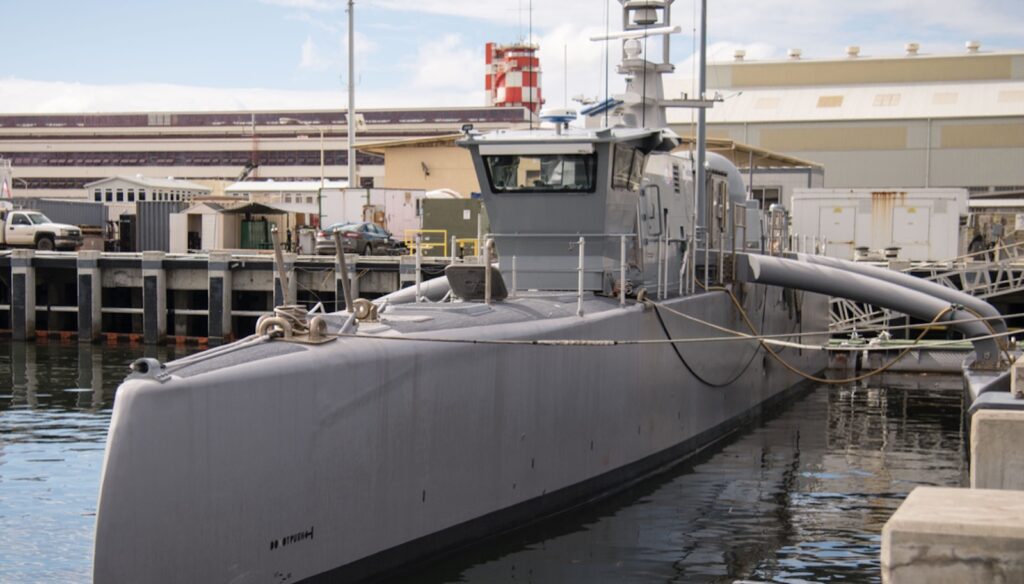
(U.S. Navy photo by Mass Communication Specialist 1st Class Nathan Laird/Released)