Gov. Kehoe’s revamped Board of Ed. meets, inheriting Missouri’s educational slide under former President Charlie Shields
Freshman Gov. Mike Kehoe shook up the Missouri State Board of Education by appointing new members last month, including a replacement for longtime President Charlie Shields, under whose leadership…
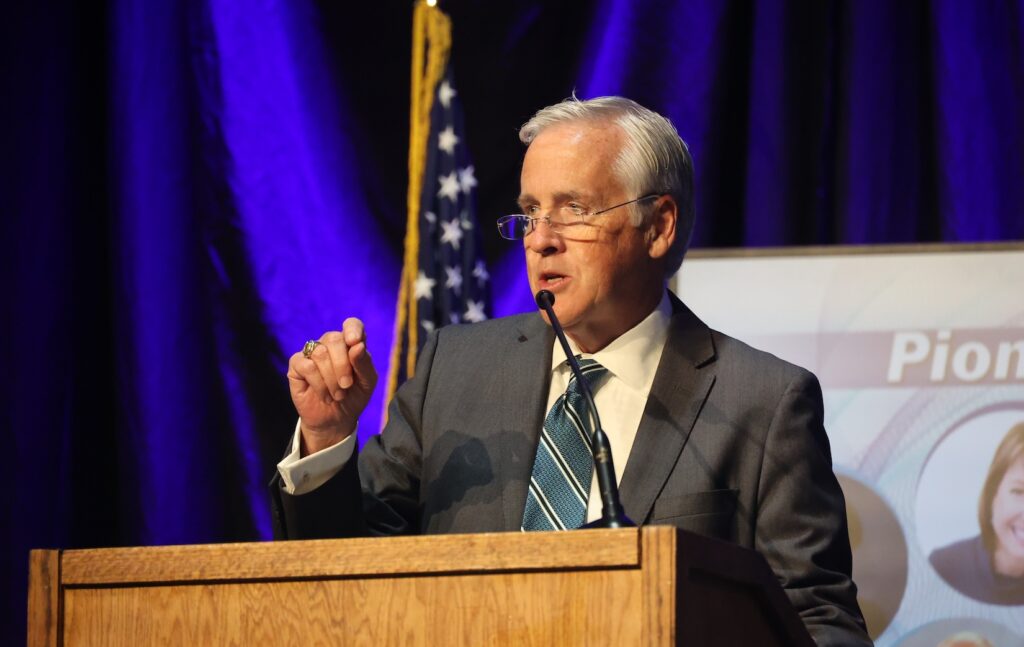
Freshman Gov. Mike Kehoe shook up the Missouri State Board of Education by appointing new members last month, including a replacement for longtime President Charlie Shields, under whose leadership education in the state significantly declined.
Kehoe, who entered office in January, nominated four new members to the eight-person state school board in April, three of whom were confirmed by the Senate and met for the first time on Tuesday: Michael Matousek, Jon Otto and Kenneth “Brooks” Miller Jr.
Shields began serving on the Missouri Board of Education (BOE) in 2012 and became president in 2015. He had previously served in the Missouri House and Senate.
The BOE consists of eight citizens serving staggered eight-year terms. Although Shields’ term expired in 2020, he and several others continued serving at the pleasure of the previous governor, Mike Parson, who did not appoint a replacement. Only Mary Schrag, the current president, is now serving on an expired term.
The new board inherits a public education system in Missouri that failed to improve over the past decade by nearly every measure.
The decline is despite the BOE’s 2014 major campaign to make Missouri one of the top 10 states for education by 2020. Nicknamed “Top 10 by 20,” the plan focused on three goals:
- Ensuring all Missouri students graduate college and are career ready;
- Improving early childhood education (ages 3-4);
- Training and developing highly effective teachers.
Rather than rising to the top 10 in the national rankings, the Show Me State slid significantly.
In 2014, CNBC ranked Missouri 20th in the nation for education. By 2025, it had slipped to 33rd, according to the U.S. News & World Report.
While many blame COVID-19 for the widespread educational slump, the pandemic only amplified a pre-existing problem.
In 2015, about 37% of Missouri students were proficient in reading and 32-38% in math, according to National Assessment of Educational Progress (NAEP) data.
By 2019 – nearing the end of the Top 10 by 20 campaign – NAEP scores had dropped three points in reading and remained the same in math.
In the most recent testing cycle, proficiency rates were markedly worse, with only a quarter of students reading at grade level and just 23% of 8th graders passing muster in math.
Pre-K enrollment has increased over the past decade, thanks to state funding, but public school enrollment declined 3% between 2012 and 2022 and is expected to fall another 4% by 2031.
College enrollment among Missouri high school graduates is also on a downward trend.
Analysis from Saint Louis University’s Policy Research in Missouri Education (PRiME) Center found a steady decline in college enrollment between 2011 and 2019.
During that decade, rates fell from 69% to 62%, during which time the national average rose from 62% to 64%. The number of students going directly into the workforce rose from 15% to 24%.
And despite the promise of highly effective educators, the BOE, under Shields, lowered teacher certification standards, citing recruitment issues.
One education policy expert called it a “bad look.”
“It certainly is a bad look when the agency that is tasked with upholding the quality of education in our state says, ‘Grades don’t matter,’” said James Shuls, former research director at the Missouri-based Show-Me Institute.
In 2023, two Missouri lawmakers sent a joint letter to Shields and his fellow board members lamenting the board’s failure to improve public education.
“As the co-chairs of the Joint Committee on Education, we know that Missouri’s public schools are struggling to achieve acceptable student academic outcomes,” former Rep. Doug Richey and former Sen. Andrew Koenig wrote. “All of this is occurring while the Missouri Department of Elementary and Secondary Education (DESE) suffers significant bloat and mission creep.”
Richey previously told The Heartlander as much as 40% of DESE’s multi-billion-dollar budget goes to non-education programs – such as Social Security disability determination and residential facilities for developmentally disabled adults.
“The one formal task that DESE is charged with is ensuring that public K-12 schools are providing quality education to Missouri children,” the two lawmakers concluded. “This is not happening.”
Photo: @MOEducation via X