Hegseth, Caine describe most ‘intense day of strikes’ on Iran; WH calls operation ‘resounding success’
Defense Secretary Pete Hegseth and Joint Chiefs Chairman Gen. Dan Caine said Tuesday that U.S. forces are dismantling Iran’s missile, drone and naval capabilities as Operation Epic Fury…
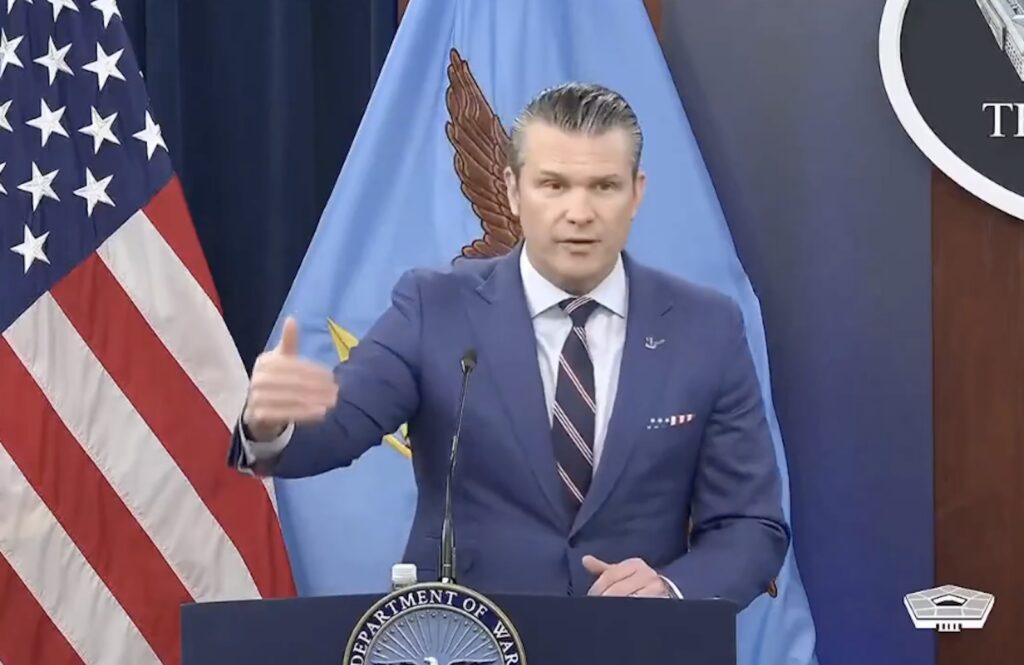
Defense Secretary Pete Hegseth and Joint Chiefs Chairman Gen. Dan Caine said Tuesday that U.S. forces are dismantling Iran’s missile, drone and naval capabilities as Operation Epic Fury enters its second week.
Pentagon officials reported a sharp decline in Iranian attacks as strikes continue against the Iranian regime’s military infrastructure.
“Today will be yet again our most intense day of strikes inside Iran, the most fighters, the most bombers, the most strikes,” Hegseth said while speaking from the Department of War. “Intelligence more refined and better than ever.”
Hegseth said the campaign remains focused on three objectives: destroying Iran’s missile stockpiles and launch systems, neutralizing its naval forces in the Persian Gulf and permanently denying Tehran the ability to obtain nuclear weapons.
“Our generation understands this fight,” Hegseth told reporters, describing Iran’s leadership as responsible for decades of attacks on U.S. troops through terrorist proxies while pursuing nuclear weapons capability.
He said the current campaign reflects a shift away from the prolonged wars of the past two decades.
Instead, it is designed to achieve specific military outcomes rather than open-ended occupation or nation-building.
More than 5,000 Iranian targets struck
Caine said U.S. Central Command has struck more than 5,000 targets inside Iran since the opening phase of the operation, focusing heavily on missile launch sites, drone factories, command networks and logistics infrastructure used to sustain attacks across the region.
According to the Pentagon, the campaign is producing measurable battlefield effects.
Iranian ballistic missile launches have dropped roughly 90% from the opening days of the conflict, while one-way drone attacks have fallen about 83%, a decline officials attribute to the destruction of launch infrastructure and production facilities.
“These strikes mean we’ve made significant progress in reducing the number of missile and drone attacks coming out of Iran,” Caine said.
Independent battlefield assessments broadly support the Pentagon’s description of the campaign.
Satellite imagery reviewed by analysts suggests several underground missile access points and support facilities have been hit, potentially slowing Iran’s ability to regenerate launch operations even if drone and missile stockpiles remain intact, according to the Institute for the Study of War.
The campaign has also expanded beyond immediate battlefield targets to include elements of Iran’s broader military-industrial base, Hegseth said.
Strikes have reportedly hit research facilities, drone production sites and technology infrastructure linked to the regime’s military command systems, according to the Institute for the Study of War.
Analysts say the strikes have also complicated the Iranian regime’s efforts to consolidate power after naming a new supreme leader, Mojtaba Khamenei.
“Mojtaba will likely face several immediate challenges, including trying to establish his legitimacy and attempting to unite and gain the support of various regime factions,” while dodging U.S. and Israeli airstrikes, the Institute for the Study of War said.
Naval battle to keep oil moving
At sea, U.S. naval forces have also targeted Iran’s maritime capabilities.
Caine said coalition forces have destroyed more than 50 Iranian naval vessels since the operation began, including a drone-carrier ship used to launch unmanned aircraft operations in the region.
The U.S. Navy has been “using a combination of artillery, fighters, bombers and sea-launched missiles,” Caine said – and, in one case, a torpedo – to destroy Iranian vessels.
The sinking of IRIS Dena, a Moudge-class frigate, by a U.S. naval vessel is reportedly the first torpedo sinking since World War II.
U.S. forces are also targeting mine-laying vessels and storage facilities believed to support Iran’s attempt to shut the Strait of Hormuz.
The effort reflects growing concern that Tehran could attempt to threaten global energy supplies by attacking shipping in the Persian Gulf.
The narrow waterway carries roughly 20% of global oil shipments. Crude prices have risen from about $65 per barrel to near $85 amid reduced traffic.
President Donald Trump has said maintaining open shipping through the strait remains a priority of the operation.
Trump told CBS News the war with Iran is “very complete,” while emphasizing that the United States will ensure the strait remains open.
“We’re really helping China here and other countries because they get a lot of their energy from the Straits,” Trump said, according to Fox News. “We have a good relationship with China. It’s my honor to do it.”
Caine also praised sailors responsible for aircraft carrier flight deck operations for sustaining the air campaign, describing the demanding process of launching and recovering strike aircraft around the clock under combat conditions.
These are young Americans directing fully loaded fighter jets “into a one foot square box” on a moving deck in the middle of the night, he said, calling the coordination between sailors and aviators “a beautiful symphony of American spirit.”
Epic Fury ‘resounding success’, White House says
White House Press Secretary Karoline Leavitt called Epic Fury “a resounding success thus far,” and said American troops “are winning this important fight at an even faster pace than we anticipated.”
“The President made unequivocally clear to the remaining elements of this terrorist regime in his statement yesterday, if they do anything to stop the flow of oil or goods within the Straits of Hormuz, they will be hit by the world’s most powerful military 20 times harder than they have been hit thus far,” she said at a press briefing Monday afternoon.
“Rest assured to the American people, their recent increase in oil and gas prices is temporary, and this operation will result in lower gas prices in the long term. Once the national security objectives of Operation Epic Fury are fully achieved, Americans will see oil and gas prices drop rapidly, potentially even lower than they were prior to the start of the operation.”
Leavitt added that Trump “will determine when Iran is in a place of unconditional surrender, when they no longer pose a credible and direct threat to the United States of America and our allies,” referencing the president’s call for the nation’s complete surrender.
(Image credit: X/Department of War)