Lawmakers push to expand school choice amid rising demand nationwide
School choice is proving popular in states such as Oklahoma, where one state representative has proposed raising the cap on the Parental Choice Tax Credit from $250 million to $300…

School choice is proving popular in states such as Oklahoma, where one state representative has proposed raising the cap on the Parental Choice Tax Credit from $250 million to $300 million.
The Sooner State established the program in 2023, allowing parents to receive credits ranging from $5,000 to $7,500 per student for private school tuition, depending on household income.
The program received nearly 27,000 applications on the first day of the application window this month, or about 70% of the applications received for the current school year, said Rep. Chad Caldwell, R-Enid. This prompted Caldwell to propose a bill to lift the cap by $50 million and institute an automatic $50 million increase every year the program reaches 90% of its capacity.
“This level of demand underscores how strongly Oklahoma families value this program and reinforces the need to expand its funding so more parents can access educational options that best meet their children’s needs,” Caldwell said in a release.
The Republican-led Legislature has until May 29 to approve the change. Applications for the program close June 15.
Continued efforts in Mississippi
Efforts are also underway to boost school choice in Mississippi, and Texas is seeing record applications to its new school choice program, part of a rising trend that is sweeping even some blue states thanks to the new federal school choice tax credit.
Mississippi made headlines in February when a school choice bill died in its Senate, but that hasn’t stopped Rep. Trey Lamar, chairman of the House Ways and Means Committee, from trying to boost tax credits for donations to private schools.
Lamar, R-Senatobia, reportedly included language related to the Children’s Promise Act in multiple bills. His initial attempt to raise the cap from $18 million to $40 million was defeated, but legislation could be amended before the session ends April 5.
A current proposal is advancing that would allow $8 million in credits for private schools, $8 million for foster care organizations and $6 million for special-purpose schools, which serve students with special needs or other nontraditional learners.
Gov. Tate Reeves, a Republican, has not said whether he will call a special session to pass school choice. Republicans control the government, but the Senate has twice killed school choice in the last two years.
Texas demand strong
In Texas, more than 244,000 applications have been received for the state’s new school choice program, which will have about 100,000 spots, and a judge extended the deadline through March 31 after three Muslim schools sued for being excluded from participating, allowing families more time to apply.
Less than half of the applicants are white, and 72% are from families earning 500% or less of the federal poverty level, or $165,000 for a family of four. Of the applicants, 77% are for private school, and 23% are for homeschool, according to the state Comptroller’s office.
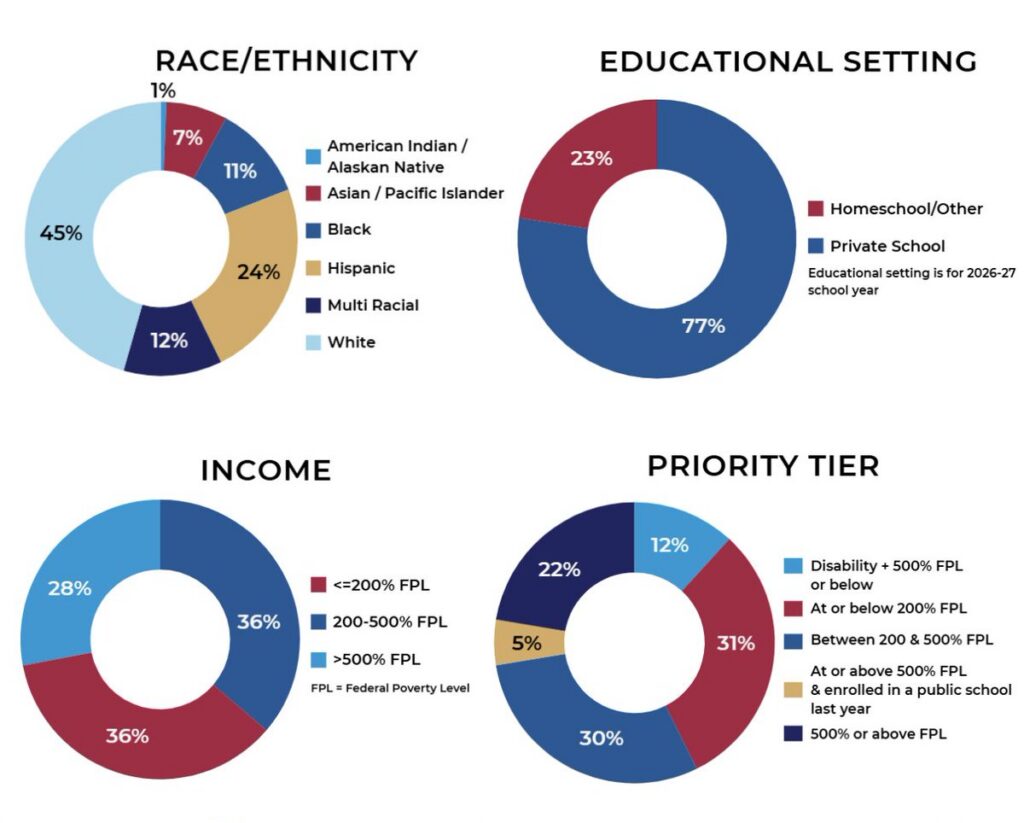
The program will provide scholarships of about $10,000 for private school students, $2,000 for homeschool students and up to $30,000 for students with special needs.
Not all news is positive, however.
A Nebraska lawmaker pulled $3.5 million in school choice funds from a budget bill, saying he didn’t think there was enough support for it.
The Cornhusker State rejected school choice on a 2025 statewide ballot measure. However, Gov. Jim Pillen already opted the state into the federal school choice tax credit, which takes effect next year.
Federal choice program has momentum
The federal credit continues to gain steam nationally, with 28 states indicating participation.
Most of them are Republican-led, or red, states, but Erika Donalds, CEO of the Education Freedom Foundation, told The National News Desk that the Democrat governors of Hawaii, New Mexico and Oregon are considering joining the program.
“These Democrat-led states, these governors, are considering opting into the federal tax credit program because it adds money to their education budgets. It doesn’t take anything away from it,” Donalds said. “And as many as 70% of even Democrat voters are saying that they would support candidates who support school choice for their children.”
To date, the only Democratic governor to join is Jared Polis of Colorado, although others, including Josh Stein of North Carolina, are considering it.
The money can help public school students with things like tutoring and other activities.
“This is long overdue and this is private funding, so it takes away the argument from the teachers unions that it’s going to harm public school budgets, which are already strained for many different reasons,” Donalds said.
“This federal tax credit is going to add billions of dollars, perhaps doubling the amount of scholarships that are going to be available for American parents to be more flexible, be able to customize their children’s education and choose the environment that is best for their kids.”
Nationally, more than 1.5 million students participate in school choice programs across 35 states.