Report: Religious decline may be plateauing
While religious beliefs have declined in the past decade, an increase in church attendance among Gen Z and Millennials may be flattening the downward curve.
“The data on this is really muddy….

While religious beliefs have declined in the past decade, an increase in church attendance among Gen Z and Millennials may be flattening the downward curve.
“The data on this is really muddy. You pick out a data point here and there and declare, ‘Gen Z is the least religious in history,’” professor and public commentator Ryan Burge said in a post on X. “Or look another data point or two and say, ‘There’s a revival happening among Gen Z.’ So, choose your own conclusion.”
A recent Pew Research study reports a decrease in religious affiliation among the global population from 2010 to 2020. The share of the global population expressing any religious affiliation declined nearly one percentage point from 76.7%, and the share without an affiliation increased nearly one percentage point from 23.35%.
Nearly a quarter of the global population (24.2%) does not identify with any religion, according to the report. These “nones” are the third-largest group with shared “beliefs” following Christians and Muslims, respectively. Nones increased by 270 million people, reaching 1.9 billion total.
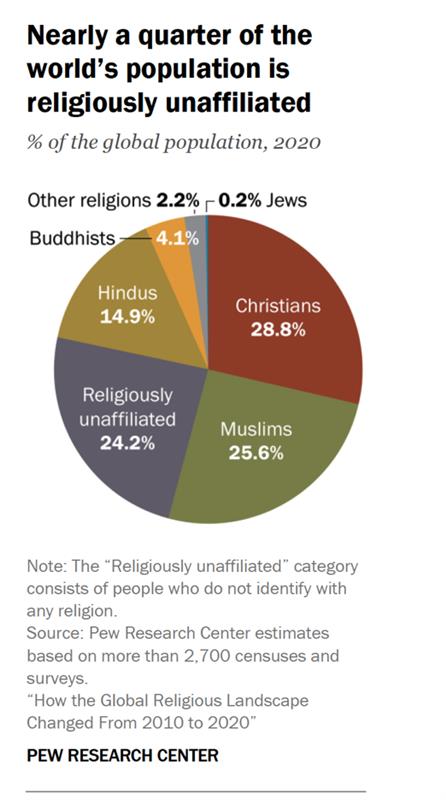
(Graph originally published by Pew Research Center)
In the U.S. in 2020, 101 million nones formed 30% of America’s population – a 97% increase from 2010.
While the total number of Christians rose by 122 million to 2.3 billion, Christians as a share of the global population fell 1.8 percentage points to 28.8%.
The number of Muslims increased by 347 million – more than all other religions combined. The Muslim percent of the global population rose by 1.8 points to 25.6%.
Along with this recent report, Pew Research released a commentary on how secularization occurs. The author, Conrad Hackett, discussed a recent published paper, “The three stages of religious decline around the world.”
In the paper, scholars present a model for understanding how people move from engaged worshippers to unaffiliated, dubbed the “Participation-Importance-Belonging sequence” (P-I-B): First, individuals participate in worship less frequently, then the personal importance of religion declines, and finally they cease identifying or belonging to a specific religion.
Based on this model, a recent resurgence in church attendance among young adults may indicate an increase in religious affiliation over the next decade (2020-2030).
Recently, the Barna Group published a study reporting Gen Zers – people ages 18 to 28 – attend church more frequently now than older siblings, parents or grandparents.
Millennials, born between 1981 and 1996, are also going to church more – 22 services per year, compared with 19 in 2012.
“The fact that young people are showing up more frequently than before is not a typical trend,” Barna’s Vice President of Research Daniel Copeland said. “It’s typically older adults who are the most loyal churchgoers. This data represents good news for church leaders and adds to the picture that spiritual renewal is shaping Gen Z and Millennials today.”
Barna’s research surveyed 5,580 participants online from January to July of this year and focused on young adults’ church attendance specifically, not the overall decline of church attendance.
While religion has declined from 2010 to 2020, this church-attendance resurgence appears to be stalling secularization.
Along these lines, Pew Research released a study in February showing Christianity’s general stability in the U.S. From 2019 to 2024, the Christian share of the population hovered between 60-64%.
The dates are notable. Because Pew’s most recent study examined data from 2010-2020, the results did not include religious trends since the onset of the COVID-19 pandemic.
“Many young people have turned to religion to find community and connection after the isolating years of the pandemic, which hit Gen Z harder than most,” Axios reported.
Whatever the causes, data suggests a levelling off of the religious decline, specifically in the U.S.
“If these trends continue, the spiritual explorations of the next generation could redefine the makeup and momentum of Christianity and of congregations in the coming decade.” Barna Group wrote.