Self-reported mental health hits 24-year low; young women, Democrats, irreligious have worst outcomes
(The Heartlander) — Mental health in the U.S. is at a 24-year low, and young women are suffering the most, according to a new poll.
Gallup research
published in March found Americans are…

(The Heartlander) — Mental health in the U.S. is at a 24-year low, and young women are suffering the most, according to a new poll.
Gallup researchpublished in March found Americans are self-reporting poor mental health following “a decadelong decline that began around 2013 and accelerated sharply with the onset of the COVID-19 pandemic in 2020.” While 89% of Americans said they had excellent or good mental health in 2012, that dropped to 75% in 2024. And there are major concerns for specific demographics. Over the past 15 years, the mental health of women aged 18-29 has dropped significantly, with a mere 15% rating it as excellent.
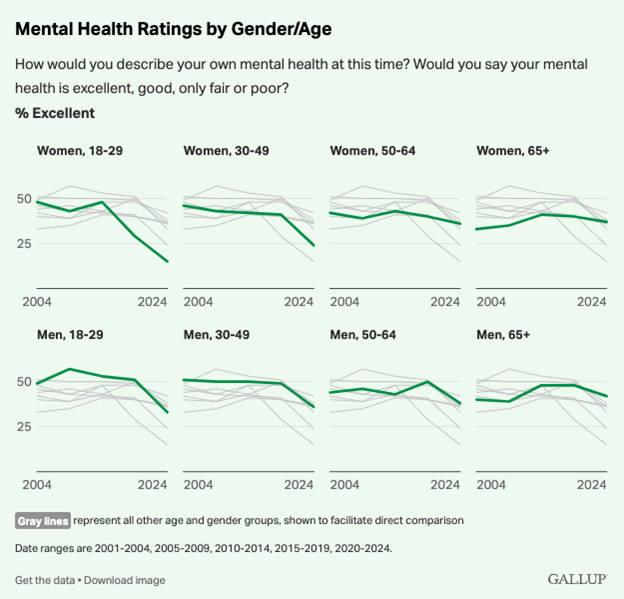
By comparison, 33% of men in the same age range report excellent mental health. Women aged 30 to 49 had a similar, though less dramatic, decline. Older men and women reported being more stable. Other groups reporting worse outcomes include irreligious people, Democrats and those from low-income households. Gallup researchers attribute the mental health decline to “heightened anxiety brought on by the COVID-19 crisis” as well as “heightened public and medical attention to mental health.” But it’s likely those aren’t the only factors. Social media and cell phone use have exploded in the past decade and are documented to have particularly adverse effects on young women. Most of the current 18 to 29-year-old women were adolescents during the advent of social media. In 2011, only
35%of U.S. adults owned a smartphone. Now it’s over 90% of adults and
95%of teens. According to Common Sense Media, 13 to 18-year-olds use social media for an average of
nine hoursa day, and tweens (ages 8-12) use it for six hours a day. But that doesn’t mean America’s youth are doomed to mental misery. Other research has shown certain groups enjoy far better mental outcomes than the general population. For example, students who are
homeschooledfor eight years or more reported more optimism, life satisfaction and gratitude. Studies also have found better mental health outcomes for those with a
Christian worldview, politically
conservativewomen, and
marriedpeople of both sexes.