Iran, Russia, China stage show of force near US warships as nuclear talks wrap
(Daily Caller News Foundation) – Iran has been joined by Russia and China in deploying naval vessels for a joint live-fire exercise in the Strait of Hormuz, heightening regional tensions even as…
(Daily Caller News Foundation) – Iran has been joined by Russia and China in deploying naval vessels for a joint live-fire exercise in the Strait of Hormuz, heightening regional tensions even as negotiators from Washington and Tehran met for diplomatic talks aimed at averting a military confrontation. Iran this week announced the naval drills in the
Strait of Hormuz, one of the world’s busiest and most strategically vital waterways, timed to coincide with the U.S.-Iran nuclear talks in Geneva. Russia and China have deployed vessels to join Iran in the Strait for the joint “Maritime Security Belt-2026” exercise taking place across mid-February. Since tensions with Tehran began escalating in late January, Washington has
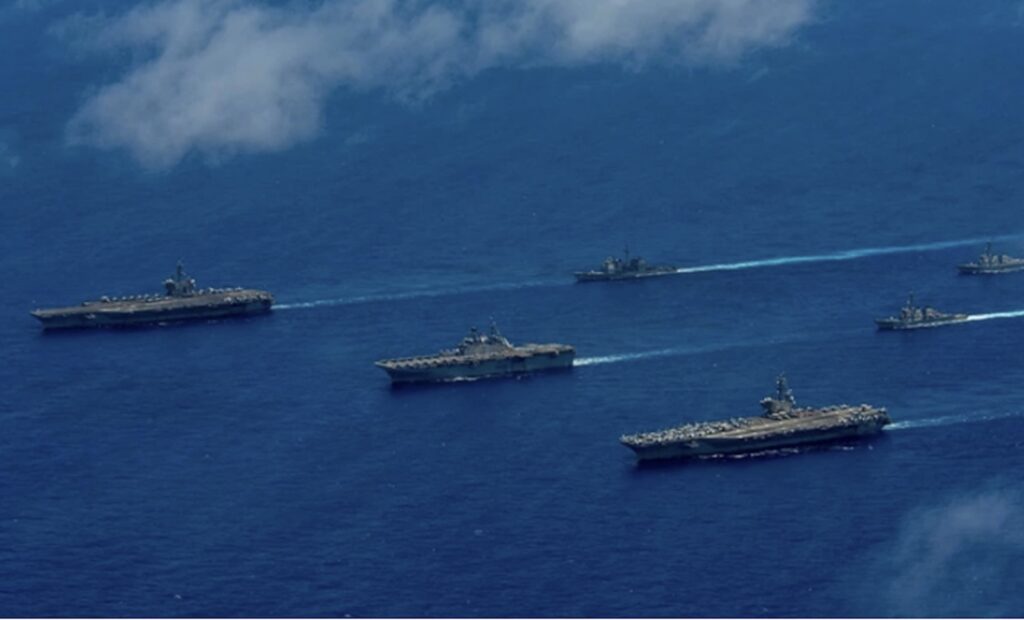
deployedhundreds of aircraft and additional naval forces to the Middle East, including two aircraft carriers. Meanwhile, Iran’s Supreme Leader Ayatollah Ali Khamenei has
warnedthat the regime is willing to use weapons to sink the U.S. ships “to the bottom of the sea.” Russian presidential aide Nikolay Patrushev told the Russian newspaper
Argumenty i Fakty (Arguments and Facts)on Tuesday that Moscow seeks to help build a “multipolar world order on the oceans,” according to a
translationof his remarks by Anadolu Agency. “We will tap into the potential of BRICS” — a bloc of developing countries seeking to erode Western hegemony — “which should now be given a full-fledged strategic maritime dimension,” Patrushev said. Iran also
closedparts of the Strait for several hours on Tuesday as the Islamic Revolutionary Guard Corps (IRGC) conducted live-fire military drills in the waterway. The announcement comes as a second round of negotiations between the U.S. and Iran wrapped up Tuesday in Geneva. The U.S. delegation was led by Special Envoy Steve Witkoff, along with presidential adviser Jared Kushner, while the Iranian side was headed by Foreign Minister Abbas Araghchi. The talks focused primarily on the Islamic Republic’s nuclear program. U.S. and Israeli officials have pushed for a broader agreement that would also address Iran’s ballistic missile capabilities, but Tehran
rejectedthe idea during negotiations. Iran and the U.S. reached an understanding on the main “guiding principles” during the second round of nuclear talks, though significant work remains, Araghchi said, according to
Reuters. “Progress was made, but there are still a lot of details to discuss,” a U.S. official told the Daily Caller News Foundation. “The Iranians said they would come back in the next two weeks with detailed proposals to address some of the open gaps in our positions.” The U.S. began moving military assets to the Middle East in late January to
bolster“regional security and stability.” The USS Gerald R. Ford — the Navy’s most advanced aircraft carrier — was
dispatchedon Friday to join the USS Abraham Lincoln and a growing contingent of guided-missile destroyers, fighter jets, and surveillance aircraft already operating in the region. Despite projecting a conciliatory demeanor in Geneva, Iranian leaders have not restrained their provocations against the U.S. and President Donald Trump. “Americans keep endlessly repeating that they’ve sent an aircraft carrier toward Iran,” Khamenei
wroteon X Tuesday, as negotiations were underway. “Well, an aircraft carrier is certainly a dangerous machine, but more dangerous than the aircraft carrier is the weapon that can sink that aircraft carrier to the bottom of the sea.” “The strongest army in the world may at times receive such a slap that it cannot rise,” Khamenei also threatened.
Les Américains répètent sans cesse qu’ils ont envoyé un porte-avions vers l’Iran. Eh bien, un porte-avions est certes un engin dangereux, mais plus dangereux que le porte-avions est l’arme qui peut couler ce porte-avions au fond de la mer.
— Ayatollah Khamenei (@fr_Khamenei) February 17, 2026
General Mohammad Reza Naghdi, senior advisor to the IRGC,
saidon Tuesday that the “United States is finished,” and that it would not be able to do a “damn thing even if it deploys 12 aircraft carriers.” The president has repeatedly said he prefers a diplomatic solution but
warnedthat failure to reach a deal could trigger a military response that would be “very traumatic” for Iran. Ahead of the meeting, Trump also
suggestedthat “regime change” in Iran “would be the best thing that could happen.”